Mechanism
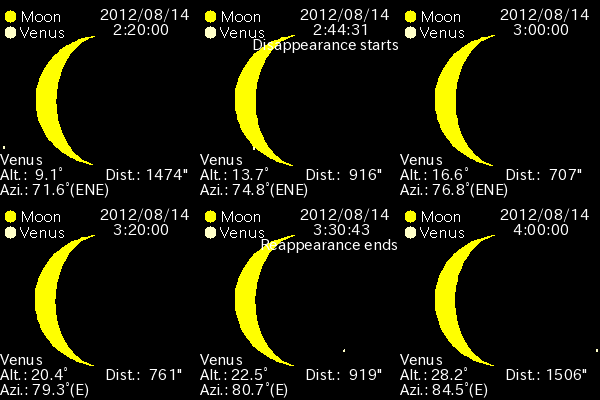
Since the Moon is the nearest celestial object from us, it passes by stars or planets during its revolutaion around the Earth. When the Moon is passes through stars, the star seem to dissapear at lunar limb and reappear at the other side of the limb. This is called lunar occultation.
The condition for observation can be bad, for example, when lunar occultation occurs in the daytime or when stars are not bright enough.
When the star is near the lunar limb, the star repeatedly dissapears at mountains and reappears at valleys. This is called grazing.
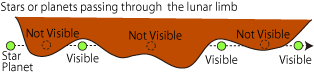
Lunar Occultation of Planet
Since planets have larger size than stars, it takes several tens of seconds for planets to dissapear or reappear.

Lunar Occultation Map
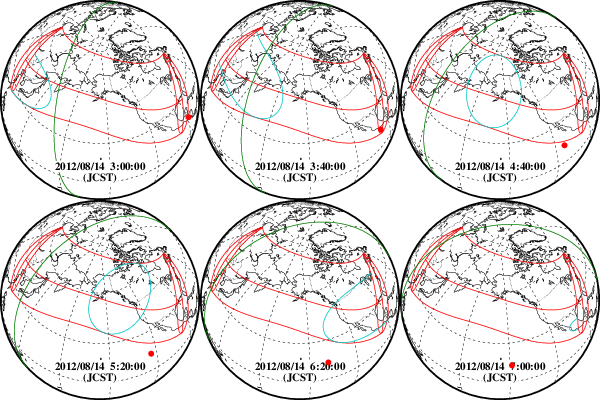
Moon is hiding the star inside the light blue line. The loci of the light blue line shown in red lines is the the area where you can see the lunar occultation.
Northern or southern limit of the red line is where you can see the star grazing the lunar limb.
Green line shows the area where the sun is rising or setting, and the small red circle is where the sun is in the zenith, which means local noon.
All Lunar Occultation Map is in Japan Central Standard Time (UT + 9h)
Position Angles
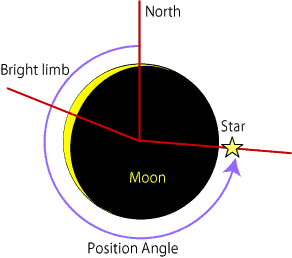
- p : Direction of the center of Star/Planet with respect to the center of Moon, measured counterclockwise from celestial north
- q : Direction of zenith with respect to the center of Moon, measured counterclockwise from celestial north
- V : Direction of the center of Star/Planet with respect to the center of Moon, measured counterclockwise from zenith, i.e. V = p - q.
- B : Direction of the center of the Sun of the Moon with respect to the center of Moon, measured counterclockwise from celestial north. This equals the direction of the bright limb.